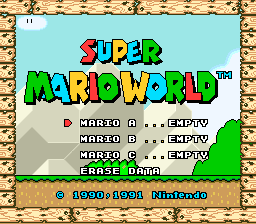
The following article is the result of me noticing something. It's not really meant to be taken seriously, and is more to be taken as something to entertain you. There may be no answer to this riddle, but I had fun exploring it. I also do not know the answer for certain. (It's either TEAL YELLOW RED YELLOW GREEN or TEAL RED YELLOW RED GREEN.)
I may repeat myself. It is 3 in the morning and I am very tired.
It started with a Twitter thread, asking this question:
S U P E R M A R I O W O R L D 1 2 3 2 4 4 2 3 1 4 3 2 4 1 4
If there's a logic to this coloration, then, here is my question:
What color would the next letter after WORLD, be?
While I don't know the answer, I doubt that it's a mathematical one. The number sequence does not appear to follow any sort of real logic: unless, of course, we assume the following:
Anyway, the next word's sequence should be something like:
From looking at the logo, we can determine the following things.
Are the vowels A, E, O, and U always Teal? Is the I always Red? It's impossible to say.
So, right off the bat, we know the following things: because the last letter of each word is probably going to be green, we can somewhat-safely ascertain that the following word coloration choice is not going to be used: X GREEN X X GREEN, or any configuration thereof (with X representing any color that is not the named color). GREEN X X GREEN X is also probably not a valid choice, for two reasons: there are no words with two different colored letters between green letters, and words seem to have to end with a letter colored green.
From this, we can ascertain the following: the following coloration is probably the most likely to occur:
X X X X GREEN
With the following coloration being an impossibility:
X X X GREEN GREEN
As well as the following colorations (some repeated) also being impossibilities:
	GREEN GREEN X X X
	GREEN X X GREEN X
	GREEN X X GREEN GREEN
	(and any colorations that include
	more than two of the same of one color,
	in a five letter word...)
Fast-forwarding, colorations seem largely dependent upon the words that follow them. Though the rules that govern this are not exactly clear.
We know that words can start with the colors Red, Green, and Yellow. But we don't know if they can start with Teal. (They most-likely can. I'll explain later.)
We know that three letters of the same color are unlikely to appear in a five letter word.
We know that colors will never touch adjacent letters within the same word.
And we know that consonants are never Teal. (Except, they are— but I'll get to that later.)
Firstly, we can ascertain that R's are usually green. 2/3s of the time, they are Green. 1/3rd of the time, they are Yellow.
The vowel O can be Teal or Green.
But, beyond these events, we cannot determine much else; because we have no repetition to work with.
(Yes, I know it was probably just colored without any thought at all, save for what looked the best. Let's have fun with this! :3c)
From all of these rules, we can guess the following things:
Given that each word's first letter has used a different color, we can guess that the next word's first letter will be colored Teal.
And, if the next word has a vowel after the first letter, it will NOT be Teal, as colors are not allowed to 'touch' one another, in adjacent letters. (And— and I wrote this while editing, after everything else was written, but— we've seen a vowel colored red; but no vowel has ever been colored yellow. Thus, it makes the most sense for a vowel to be colored red.)
From the three words we're given, we can surmise that the next word will most likely be five letters.
Here's the fucked-up part: I'm right about the next letter being Teal.
Look at the trademark symbol.

Though, to be perfectly honest, we don't know that the next first letter will be Teal, from this evidence. We merely know more about the distribution of colors, if the trademark symbol is considered a character that follows the color distribution rule we haven't figured out yet. If it is just another character, then we can ascertain the following: that Teal appears in the distribution, at most, every four letters; but, more than likely, it should appear either every other letter, or twice every four letters; it follows a greater distribution of its coloration appearing every 1-4 characters.
Knowing what we know now, if there was another word after Super Mario World, what would its most-likely coloration be?
Well, its first letter would be Teal. And then, it would either end with a Teal final letter; and if it didn't, then any of the other colors could do a duplex like XYX, in the middle of the word, or at the end of it. (like RED YELLOW RED). But if we assume the last letter will be Green, then the coloration of the last word will most-likely be:
TEAL [A COLOR THAT IS NOT TEAL OR GREEN; SO YELLOW OR RED] [A COLOR THAT IS NOT THE ADJACENT COLOR: so, if it's the previous letter is yellow, this could be red or green, but not teal; if the previous letter is red, then this letter is yellow or green, but not red]—
This is getting very difficult. Let me lay out the possible combinations.
Let's assume we know that the first letter will be Teal, and the last will be Green. Probably, this word will not follow the GREEN X GREEN ending coloration of the previous word. So we can rule that one out.
So, the following coloration would be the most-likely:
TEAL X X X GREEN
But how many colorations are possible?
	TEAL RED YELLOW RED GREEN
	TEAL YELLOW RED YELLOW GREEN
	TEAL YELLOW GREEN RED GREEN
	TEAL RED GREEN YELLOW GREEN
As a Red letter has never been second, and a yellow letter has never been second as well, this brings us to an impasse. However, the second letter also cannot be green; and it cannot be teal.
In every word in Super Mario World, the second letter has always been Teal.
So we cannot answer this question at all, using the data available to us, as we have not seen (as far as I can see!) enough to safely predict the next letter.
It could always just be Red or Green.
Probably it would be Red, seeing as they don't seem to want to have colors all that close to one another.
Given that the GREEN X GREEN coloration is unlikely to appear in the subsequent word after WORLD, I'm gonna take a big fat fuckin' guess and say this is what it would be colored:
TEAL NOTGREENORTEAL NOTGREENORTEAL NOTGREENORTEAL GREEN
Given that Teal and Green have appeared four times each in the logo, and yellow and red have appeared 3 times apiece, And, given that the first letter's color has never been repeated like FIRSTLETTERCOLOR X FIRSTLETTERCOLOR, we can say that the middle letter probably won't be teal, either.
Given that RED appears again about 8 letters after its first appearance, then 6 after its second appearance, and yellow appears FIVE letters after its first appearance, and then shows up again two letters later? This seems to suggest that the next color, two letters after its last appearance— red— would be the second letter.
So, most likely, the coloration of the next five-letter word after WORLD, would be:
TEAL RED YELLOW RED GREEN


Interesting aside: if you graph the colors that the Super Mario World logo uses (Red is
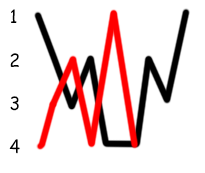



Fuck.
Do you think they stopped extending the coloration beyond 'Super Mario' because it was just too hard to find shit that looked good?
I do.
In conclusion, ladies and jellyspoons . . . more than likely, there's no real 'logic' behind the coloration of the Super Mario World logo. I merely noticed something; wanted to see if I could figure it out; all the while realizing, there probably was no real logic behind the coloration. The colors are arbitrary; it was probably just colored that way so that it would 'pop'. There might be some sort of rule of graphic design that I am not aware of.
And, to be fair, that's probably all they were thinking about, when they made this logo. If you look at Super Mario 64's development, you can see, plain as day, that the people making that game were running by the seat of their ass. There was a lot of thought put into it; but I doubt, quite highly, that the logo has any real discernible log ot it.
However, I am a cryptologist. When I see patterns, I find it interesting to investigate. Since I was a kid, I've been making my own cryptographic methods; I even figured out a way to turn S'pht from Marathon 1 into a somewhat functioning alphabet.
Going into this, I was hoping that I could find some real logic behind it; so that, perhaps, I could turn it into something beautiful. Unfortunately, it's rather haphazard; and I think the only real 'logic' to it, is, 'letters of the same color don't touch within the same word'; followed by, possibly, 'almost every vowel is Teal, while the second letter of every five-letter word is Teal; and all five-letter words end with a Green final letter.
I'm disappointed, but I had fun doing this.
If you've found anything interesting about this, or you found something that I did not, feel free to opine about it. I'm interested to hear what you think. :>

Beyond that, it is now 4:38 a.m., and I have been thinking about this for nearly 3(
Just— one more thing—
From everything we've just learned today, the letter directly preceding the S in Super, should be Green. And the first letter of the word preceding Super, should be Teal.
So it all wraps around. Crazy!